
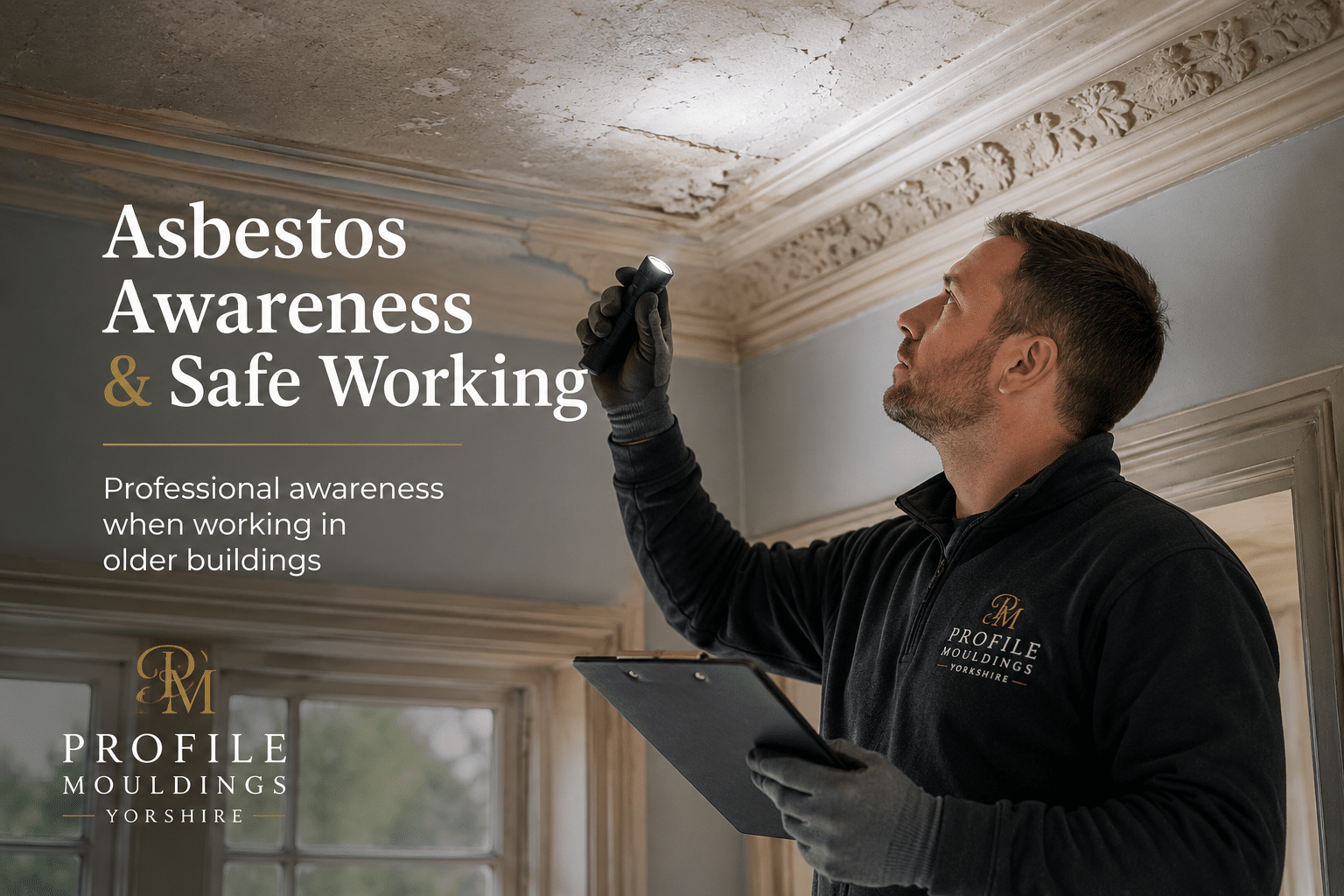
Professional awareness when working in older buildings
Was your property built or refurbished before 2000?
If so, asbestos could be present.
Asbestos was widely used in UK buildings before its use was banned in 1999, and asbestos-containing materials can still be found in buildings today. HSE guidance says that if a building was built or refurbished before 2000, asbestos should be assumed to be present unless there is information to indicate otherwise.
BEFORE YOU BOOK WORK
Was your property built or refurbished before 2000?
Asbestos could be present.
Asbestos was widely used in UK buildings before its use was banned in 1999. HSE guidance says that if a building was built or refurbished before 2000, asbestos should be assumed to be present unless there is information to indicate otherwise.
This is particularly important when carrying out work that may disturb the existing building fabric — including drilling, fixing, cutting, refurbishment or installation work.
Asbestos awareness is an important part of professional plasterwork, particularly when working in older homes, period properties, commercial buildings and refurbishment projects. At Profile Mouldings Yorkshire, we believe responsible installation involves understanding the existing building and the materials that may be encountered.
This is particularly important when working in older homes, period properties, commercial buildings and refurbishment projects, where existing materials may not always be immediately identifiable.
Asbestos is one of those considerations.
Asbestos was used extensively in UK buildings and can still be found in properties today. Importantly, it is not always found in the materials people immediately associate with asbestos.
It can occur within coatings, textured decorative finishes, paints and other building materials that may look completely ordinary.
This is particularly relevant to tradespeople carrying out work to existing walls and ceilings.
We believe recognising that possibility is part of responsible professional practice.
Asbestos is not always obvious
One of the biggest misconceptions about asbestos is that it is always something that looks obviously hazardous.
It isn’t.
Asbestos-containing materials can include products where asbestos fibres have been incorporated into another material or coating.
HSE guidance specifically identifies asbestos-containing materials where fibres are bound within a matrix such as paint or plastic, and gives drilling of textured decorative coatings for the installation of fixtures and fittings as an example of non-licensed asbestos work.
This is why visual appearance alone should never be relied upon to confirm that an unknown material is asbestos-free.
A painted surface may simply look like painted plaster.
A textured ceiling may simply look like an old decorative finish.
An older coating may look completely unremarkable.
You cannot safely identify asbestos simply by looking at it.
Why this matters to plasterwork
Decorative plasterwork can involve working directly against existing ceilings and walls.
Depending on the property, proposed work may involve:
- drilling
- fixing
- cutting
- removing existing finishes
- preparing surfaces
- working around existing coatings
- accessing areas that have not previously been disturbed
In an older property, it is therefore important to consider what may already be present before work begins.
This is particularly relevant when installing cornices, coving, ceiling features, wall mouldings, decorative panels or other plasterwork onto an existing surface.
Previous asbestos-related training and experience
Our awareness of asbestos is not based solely on reading about the subject.
Before establishing Profile Mouldings Yorkshire, we previously undertook specific training relating to working with certain asbestos-containing materials.
This included practical work involving drilling through an asbestos-containing paint or coating to install fixings.
The training involved formal instruction followed by an assessment.
That experience gave us a particularly important understanding:
Asbestos is not always obvious — and seemingly ordinary materials can require careful consideration before they are disturbed.
HSE’s current guidance confirms that workers whose activities may disturb asbestos-containing materials require the appropriate level of information, instruction and training for the work being undertaken. It specifically identifies drilling holes in asbestos materials as an example where training beyond basic asbestos awareness may be required.
Keeping training current
Previous training and experience are valuable, but we do not regard an old training course as a substitute for current competence.
Current asbestos awareness is an important part of ensuring that previous experience remains relevant to the work being undertaken today.
Where work requires a level of asbestos training beyond awareness, we would ensure that appropriate current training and any necessary refresher requirements are met before undertaking that work.
HSE currently states that refresher information, instruction and training for non-licensed asbestos work should be appropriate to the work being undertaken and should normally be provided annually, or more frequently where circumstances or training needs require it.
Our approach if asbestos is suspected
Our approach is simple:
Stop.
If we encounter a material that we reasonably suspect may contain asbestos, we will stop work in the affected area rather than knowingly disturb it.
Do not disturb.
We will not continue drilling, cutting, scraping, sanding or removing a suspect material simply to complete an installation.
Seek appropriate advice.
Where necessary, we will recommend appropriate specialist assessment, sampling or other professional advice before the work proceeds.
Reassess the work.
Once the material and the proposed work have been properly assessed, the appropriate next step can be determined.
This may mean obtaining an asbestos survey, arranging specialist testing, using a suitably competent asbestos contractor, changing the proposed method of work or deciding that the planned work should not proceed.
We know the difference between awareness and asbestos work
There is an important distinction between being asbestos-aware and being trained to undertake specific work that may disturb asbestos-containing materials.
HSE describes three broad levels of asbestos information, instruction and training:
- Asbestos awareness
- Non-licensable work with asbestos, including Notifiable Non-Licensed Work (NNLW)
- Licensable work with asbestos
Basic asbestos awareness training is intended to help workers recognise asbestos and avoid disturbing it. It does not prepare someone to carry out work that will disturb asbestos-containing materials. Additional training is required where the nature of the work demands it.
This distinction matters.
We will never suggest that asbestos awareness alone makes someone qualified to work with asbestos.
Not all asbestos work is the same
Whether work involving asbestos requires a licence, notification or neither depends on the material, its condition, the proposed work and the level of risk.
For example, HSE identifies drilling textured decorative coatings for fixtures and fittings as an example of non-licensed work, while other types of asbestos work can require notification or a licensed asbestos contractor.
This is why blanket statements such as “we can work with asbestos” are misleading.
The correct approach is to consider:
- what material is involved
- whether asbestos is actually present
- the condition of the material
- what work is proposed
- how the material may be disturbed
- the likely level of exposure
- whether the work is licensed or non-licensed
- whether notification is required
- what training, controls and protective measures are required
Where the work falls outside our competence or requires a licensed asbestos contractor, we will not undertake it.
Older properties deserve particular care
Many of the properties requiring decorative plasterwork are older buildings.
Victorian and Edwardian houses, period properties, older commercial premises, public buildings and refurbishment projects can contain materials installed many decades ago.
HSE advises that asbestos can be present in buildings constructed or refurbished before 2000 and may be hidden within the building fabric.
This does not mean that every older property contains asbestos.
It means that it should not simply be assumed that it doesn’t.
That distinction is particularly important when existing ceilings and walls are going to be drilled, fixed into, opened up or otherwise disturbed.
Asbestos surveys and refurbishment work
Where asbestos may be present, the appropriate type of survey depends on the circumstances.
For larger refurbishment projects, a refurbishment and demolition survey may be required to locate asbestos-containing materials that could be disturbed by the proposed work.
For non-domestic premises, those responsible for the building may also have specific duties relating to asbestos management.
HSE states that information about known or presumed asbestos-containing materials should be made available to contractors whose work could disturb them.
If you already have an asbestos survey, asbestos register or relevant building information, we encourage you to provide it before work begins.
Particularly relevant to heritage and period properties
Our work often involves existing buildings rather than new construction.
That means understanding the building is part of the job.
With heritage, listed and period properties, there may be layers of previous alterations, coatings and repairs that are not immediately apparent.
Our approach combines traditional decorative plasterwork with modern surveying and careful preparation.
Where there is uncertainty about an existing material, we would rather stop and ask the right question than make an assumption that could put people or the property at risk.
We know our limits
Profile Mouldings Yorkshire is a decorative plaster mouldings manufacturing and installation company.
We are not an asbestos surveying company or a general asbestos removal contractor.
We do not claim that visual inspection can confirm the presence or absence of asbestos.
We will not undertake higher-risk asbestos work simply because it is possible to do so.
Where specialist asbestos assessment, testing, removal or other specialist work is required, the appropriate competent professional or licensed contractor should be used.
HSE makes clear that a training certificate by itself is not proof of competence, and that training must be appropriate to the work being undertaken.
Knowing our limits is part of working professionally.
What happens if we encounter something unexpected?
If suspected asbestos is encountered during an installation, our procedure is straightforward.
We stop work in the affected area.
We do not deliberately disturb the material further.
We communicate the issue to the relevant person responsible for the property.
Where necessary, we recommend appropriate specialist assessment.
The work is then reconsidered once sufficient information is available to determine how it can safely proceed.
This forms part of our wider approach to careful project planning and professional installation.
This approach protects our customers, ourselves and other people who may be working in or occupying the property.
A simple message for homeowners
If you are planning decorative plasterwork in an older property, you do not need to panic about asbestos.
You simply need to avoid making assumptions.
If you have an existing asbestos survey, register or other information about the property, tell us before work begins.
If you are unsure about an existing material that our proposed work could disturb, raise it with us.
It is far better to identify a potential issue before drilling into a ceiling than after the work has started.
Why we have made asbestos awareness part of our website
We have deliberately created this page because we believe customers should know that responsible installation involves more than the visible finished product.
A professional installer should understand:
- the age and character of the building
- the materials they may encounter
- the risks associated with disturbing existing materials
- the limits of their own competence
- when specialist advice is required
- when work should stop
For us, asbestos awareness is part of that wider approach.
For Profile Mouldings Yorkshire, asbestos awareness is simply part of responsible professional working.
Good workmanship starts before the first hole is drilled.
Important information
The information on this page is provided for general awareness and should not be treated as an asbestos survey, asbestos assessment, asbestos testing service, asbestos removal service or legal advice.
The presence or absence of asbestos cannot reliably be established by visual inspection alone.
Where asbestos is suspected, appropriate assessment should be undertaken by a suitably competent professional.
Any asbestos-related work must be assessed according to the specific material, condition, proposed task and applicable legal requirements.
Profile Mouldings Yorkshire will not knowingly disturb suspected asbestos-containing materials and may stop work where asbestos is suspected until appropriate specialist advice or assessment has been obtained.
Further information from the Health and Safety Executive
The Health and Safety Executive (HSE) provides the UK’s authoritative guidance on asbestos safety, including information about asbestos-containing materials, surveys, training, non-licensed work and licensed asbestos contractors.
Useful HSE guidance:
- HSE – Asbestos information, instruction and training
- HSE – Non-licensed work with asbestos
- HSE – Notifiable non-licensed work (NNLW)
- HSE – Asbestos Essentials
- HSE – Deciding if work must be carried out by a licensed contractor
These resources should be consulted where more detailed asbestos information is required.
Planning plasterwork in an older property?
If you are planning cornice, coving, ceiling restoration, decorative plasterwork or other installation work in an older building, tell us about any known asbestos information before work begins.
If you are unsure about an existing material that may be disturbed by the proposed work, raise the issue before installation.
Contact Profile Mouldings Yorkshire to discuss your project and any relevant considerations before work begins.
Profile Mouldings Yorkshire
Traditional craftsmanship. Modern surveying. Responsible installation.