Turn your ideas, photographs and designs into unique architectural plasterwork.
Turn your ideas, photographs and designs into unique architectural plasterwork.
Our bespoke 3D personalised plaster mouldings can transform photographs, portraits, meaningful figures and original designs into unique architectural features for your home, commercial property or specialist project.
What if a family portrait, meaningful figure, distinctive pattern or completely original design could become part of the architecture of your home?
At Profile Mouldings Yorkshire, we can take personalised designs and develop them into bespoke three-dimensional plaster features, incorporating them into cornices, friezes, wall mouldings and other architectural details.
From a single portrait to a series of figures integrated into an ornate cornice, every design can be developed specifically for your project.
This isn’t simply 3D printing. It’s bespoke architectural moulding.
From Photograph to Plaster
A photograph can become the starting point for something completely unique.
Our bespoke 3D personalised plaster mouldings are developed from photographs, reference material or your own ideas, creating three-dimensional designs suitable for incorporation into cornices, friezes, wall mouldings and other architectural details.
Using photographs, reference material or your own ideas, we can develop a three-dimensional design suitable for incorporation into a plaster moulding.
This could include:
- Individual portrait busts
- Family or group portraits
- Figures and characters
- Personalised motifs
- Heraldic or decorative designs
- Logos and emblems
- Repeating patterns
- Botanical or natural forms
- Bespoke architectural details
- Completely original decorative concepts
The finished design can then be incorporated into a larger architectural feature rather than simply existing as a standalone ornament.
Bespoke Cornice With a Difference
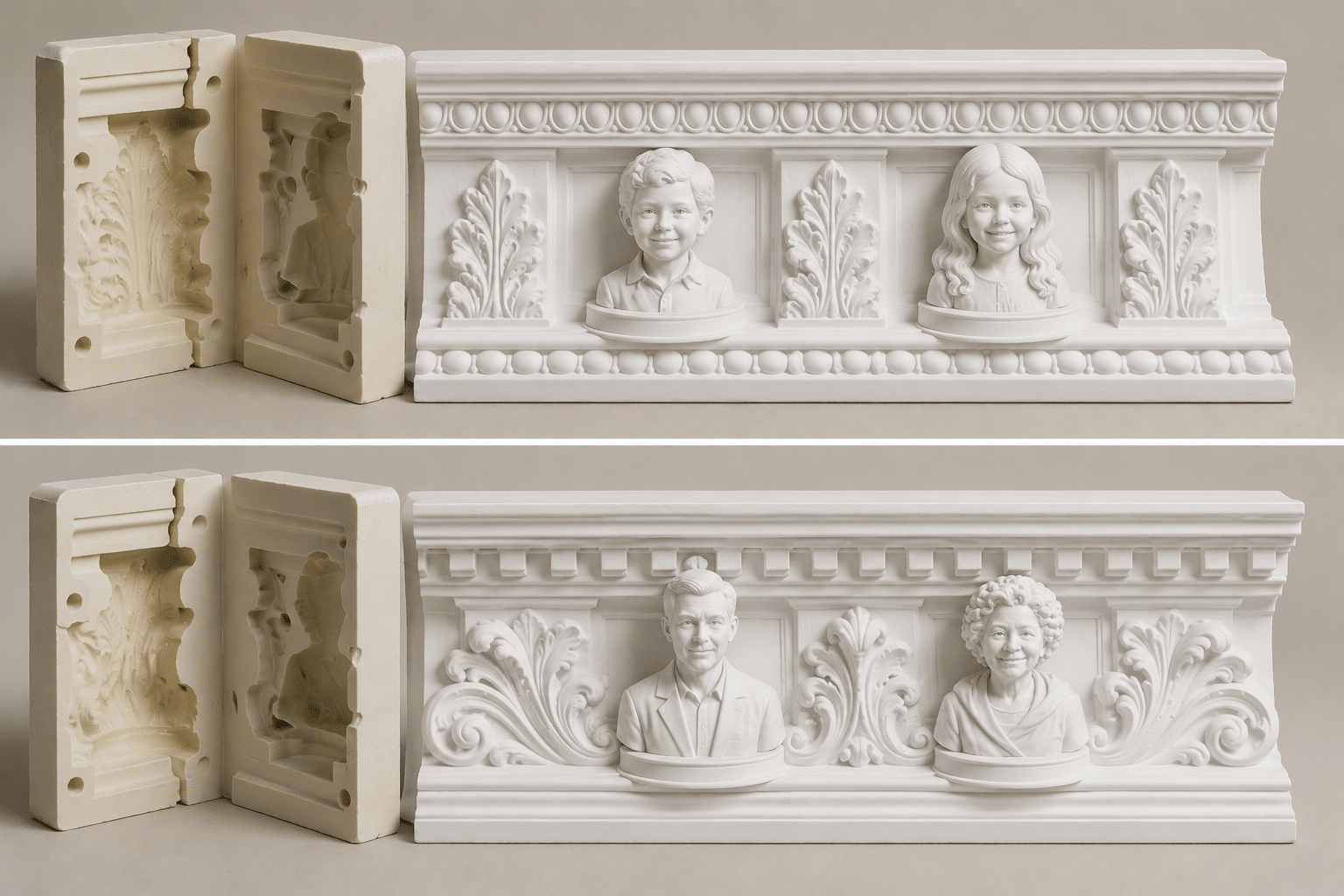
Imagine a traditional architectural cornice running around a room, but instead of conventional decorative blocks or repeating motifs, selected sections contain beautifully sculpted three-dimensional portraits.
The result could be subtle and classical, highly decorative, or completely contemporary.
We can combine personalised elements with traditional architectural details such as:
Dentils • Egg & Dart • Acanthus • Foliage • Fluting • Recessed Panels • Beading • Classical Friezes
This allows the personalised elements to become part of the architecture rather than looking like an object simply attached to it.
Designed With Manufacturing in Mind
Creating a convincing 3D design is only part of the process.
For bespoke plasterwork, the design also needs to be manufacturable.
A digital model may look fantastic on a screen but still be unsuitable for producing a practical mould.
We therefore consider the physical manufacturing process from the beginning.
Undercuts
Deep undercuts can make a design difficult or impossible to remove from a mould without damaging the casting.
Release
The shape needs to be capable of releasing from the mould cleanly.
Depth and Detail
Fine details need enough physical definition to survive the moulding and casting process.
Strength
Delicate projections may need to be modified so the finished plasterwork is sufficiently robust.
Section Size
The overall design needs to work with the dimensions and weight of the finished moulding.
Joining and Installation
Where a feature is larger than a single casting, the design can be considered in sections so that it can be manufactured, transported and installed properly.
This is where traditional plaster moulding experience becomes particularly important.
From Digital Design to Physical Plaster
Our approach can combine modern digital techniques with traditional plaster moulding and installation.
1. Your Idea
Send us your photographs, sketches, reference images or simply explain what you have in mind.
2. 3D Development
The design can be developed into a three-dimensional form suitable for the intended architectural application.
3. Manufacturing Assessment
We assess the design for moulding, release, detail, strength and practical production.
4. Master & Mould
A suitable master can be produced and used to create the mould required for casting the finished plaster component.
5. Plaster Casting
The personalised element is cast using appropriate plaster materials and manufacturing techniques.
6. Finishing
Castings can be cleaned, refined and finished before being incorporated into the completed architectural feature.
7. Installation
Where required, Profile Mouldings Yorkshire can manufacture and install the finished bespoke plasterwork as part of the wider project.
Two Completely Different Designs — One Bespoke Approach
Every project can be different.
One customer might want a traditional classical cornice containing subtle family portraits.
Another might want something much more elaborate, incorporating flowing foliage, figures and personalised decorative details.
The underlying principle remains the same:
Design it. Manufacture it. Cast it. Finish it. Make it work as architecture.
More Than a Decorative Object
A personalised plaster feature doesn’t have to be a standalone sculpture sitting on a shelf.
It can become part of the room itself.
Imagine:
- A family home with portraits incorporated into a feature cornice
- A grand entrance with bespoke heraldic plasterwork
- A restaurant or hotel featuring its own history within the interior
- A period property with newly created decorative details matching existing plasterwork
- A theatre or film set requiring completely original architectural features
- A memorial or commemorative interior feature
- A unique ceiling or wall design created specifically for one property
The possibilities are limited mainly by the design, the space and what can be manufactured successfully.
Personalised Plasterwork for Period & Heritage Properties
For heritage and period properties, bespoke reproduction can be particularly valuable.
Where an original decorative feature has been damaged or lost, modern digital techniques can potentially help recreate the missing detail while retaining the character of the original architecture.
Where appropriate, we can work from:
Photographs • Existing Fragments • Profiles • Measurements • Templates • 3D Scans
This can be particularly useful when dealing with unusual, damaged or incomplete decorative plasterwork.
Modern Technology. Traditional Craftsmanship.
Profile Mouldings Yorkshire combines modern digital design and surveying techniques with traditional plaster moulding and installation.
Our Laser 3D Scanning & Digital Surveying capability can also be used where accurate physical information is required for a project.
This combination allows us to approach bespoke work from both sides:
The digital model needs to be accurate.
The mould needs to work.
The plaster needs to cast correctly.
And the finished feature needs to look right in the building.
Could Your Idea Become Plasterwork?
You don’t need to have a finished design.
In fact, you don’t even need to know exactly how it could be manufactured.
If you have an idea, photograph, drawing or unusual architectural feature you’d like to explore, talk to us.
We can look at the concept and determine what may be possible from a design and manufacturing perspective.
Start Your Bespoke Project
Tell us what you have in mind and send us your photographs or reference material.
Request a Bespoke Quote
Have an Idea That Doesn’t Exist Yet?
Let’s see if we can make it.
From personalised portraits to completely original architectural details, Profile Mouldings Yorkshire creates bespoke plasterwork designed specifically for your project.
Contact Profile Mouldings Yorkshire
Frequently Asked Questions
Can you turn a photograph into a 3D plaster portrait?
Potentially, yes. Photographs can be used as reference material for developing a three-dimensional portrait or decorative element. The suitability of the photographs and the complexity of the proposed design will affect the final result.
Can the portraits be incorporated into a cornice?
Yes. One of the possibilities is to integrate personalised three-dimensional elements into a larger cornice or frieze design, alongside traditional decorative details.
Can you make completely new cornice designs?
Yes. Bespoke designs can be developed around the requirements of a particular room, building or project.
Does the design have to be suitable for a rubber mould?
Not necessarily. The appropriate mould-making method depends on the geometry, size, detail and intended casting process. We assess the design from a manufacturing perspective before committing to production.
Can you reproduce an existing decorative feature?
Where suitable reference material or an original sample is available, bespoke reproduction may be possible. This is particularly useful for damaged or missing decorative plasterwork.
Can you make the finished plasterwork in sections?
Yes. Larger features can be designed and manufactured in practical sections where required, allowing them to be transported, handled and installed correctly.
Can you install the finished bespoke plasterwork?
Yes. Profile Mouldings Yorkshire specialises in both manufacturing and installation, allowing us to consider the complete process rather than simply supplying a component.
How do I start?
Send us your idea, photographs, measurements or reference material. We can then discuss what you would like to achieve and assess the project from a design and manufacturing perspective.